
Small town, big headlines: The (real) Paper is beating the odds
Teri Saylor
Special to Publishers' Auxiliary
Mar 1, 2026

By now, many people have heard about “The Paper,” a mockumentary sitcom depicting a fictional newspaper in Toledo that has fallen on hard times and is struggling to reinvent itself.
The storyline follows the fictional “Toledo Truth Teller,” a newspaper owned by a corporation that makes toilet paper, and the earnest new executive editor sets out to rebuild the newsroom with more humor than effectiveness.
While the TV show puts a funny spin on corporate cost-cutting, the loss of institutional knowledge in newsrooms and the idealistic aspirations of editors who believe in good journalism, it is a sober reminder that legacy newsrooms are fading.
However, it’s not all doom and gloom in some parts of the country, where spunky start-ups are forming small oases in the news deserts left behind when long-time newspapers shrink and fold.
Enter The (real) Paper, launched February 4, 2023, in the foothills of the Blue Ridge Mountains, where it competes for local readers and advertising alongside the storied Morganton News-Herald, a 140-year-old, corporate-owned daily newspaper with a regional reach. The daily is part of a small group of Lee Enterprises’ community newspapers serving five neighboring counties.
For publisher Allen VanNoppen, it was only natural to start The Paper in a town that has historically enjoyed intensely local news and is clamoring for more.
“We haven’t invented anything new,” VanNoppen said. “All we’ve done is give people what they want.”
According to the October 2025 State of Newspapers Report published by the Northwestern University Medill School of Journalism, news deserts have hit an all-time high, leaving 213 counties and 50 million Americans with limited-to-no-access to local news.
Despite the deepening loss of local media, Medill researchers have found cause for optimism. More than 300 local news startups have launched over the past five years, 80% of which were digital-only outlets.
GOING STRONG
The Paper, a weekly print and digital newspaper, is entering its fourth year and is going strong.
VanNoppen, a Morganton native, started his career at The News Herald and spent most of his early newspaper career at the Greensboro (North Carolina) News & Record before moving back to Morganton and pivoting to marketing, first in the furniture industry and later as the owner of VanNoppen Marketing.
Through it all, he never let go of community journalism and had harbored a 20-year-old dream of starting his own newspaper in Morganton, knowing that success would hinge on good timing.
“The News Herald was long dominant, and there were conversations among people in town who wanted an intensely local community newspaper,” he said. “But the timing never seemed right” … until 2021, when he began putting together a model, researching successful community newspapers around the country and learning from them.
“The more I learned, the more optimistic I felt better about it,” he said.
He tapped Bill Poteat, a local award-winning writer and editor, to help build a newsroom focused on the traditional old-school community newspaper model.
Poteat was uniquely qualified for the job. He was The News Herald’s editor for 18 years before leaving in 1999 to teach English at a local high school. After retiring from teaching, he was a part-time columnist at another area newspaper. Today, he’s The Paper’s editor emeritus.
Executive Editor Angela Copeland was one of The Paper’s new hires, coming on board as a part-time education reporter. A native of South Carolina, Copeland and her husband had moved to Morganton from Texas to be closer to family. A graduate of Auburn University in Alabama, her first job was at the Montgomery Advertiser. Through her career, she had also worked in the local government, legal and wellness sectors, making her uniquely qualified to lead The Paper’s newsroom.
“The newspaper continues to evolve, and it’s been great,” she said.
The Paper still has a newsroom of four reporters and three editors who produce 35-40 stories each week, a hefty headcount for a weekly newspaper. Two advertising and business professionals, a circulation director, a creative director and VanNoppen as publisher, round out the team.
NAMING RIGHTS
With a new enterprise comes naming, branding and establishing a unique identity. Wearing his marketing hat, VanNoppen focused on appealing to a broad audience while being edgy enough to cut through an information-saturated digital landscape.
He can recite a litany of typical newspaper titles – the Post, the Journal, the Gazette, the Times and many others. He wanted his newspaper to stand out, so he went back to the basics and thought of the way people refer to their local newspaper.
“We like to say: ‘I’m going to get the paper, or I saw your name in the paper,’” he said. “Because the paper is what it is, and that’s what everybody’s going to call it.”
He reasoned that putting “The Paper” in the flag would amount to automatic branding.
Some people scoffed at the idea, VanNoppen said, and others thought it was sheer genius.
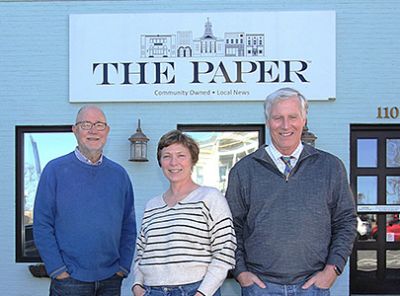
The Paper’s distinctive flag includes a line drawing of Morganton’s modest skyline, giving it a distinctive look and a sense of place.
Morganton, the seat of Burke County, is a small, politically conservative town of about 17,500 residents and sits along the Catawba River. Gazing toward the west, it’s easy to see how the Blue Ridge Mountains got their name, their rolling ridges appearing as blue shadows against the sky.
The town is about 200 miles west of Raleigh, the state capital. Among its prime bragging rights is the fact that it has five exits off I-40.
The Paper is published out of a small storefront in the heart of downtown, about two blocks from the county courthouse.
HURRICANE HELENE
On September 27, 2024, Hurricane Helene sent Burke County reeling and shut down local businesses, including the newspaper office, for about a week, but that didn’t stop The Paper from publishing.
“We didn’t have internet, electricity or transportation, but we were determined to get a newspaper out,” VanNoppen said. “And we did, using various wireless capabilities and working remotely.”
Copeland drove about 50 miles east to Statesville, North Carolina, and worked from a hotel room.
In the hurricane’s aftermath, the team published a digital daily that focused on recovery efforts and listed places where residents could find resources.
“Everybody in the community clamored for any information they could get about which businesses were open, where they could get a generator and how they could get help cleaning up,” Copeland said.
The staff published an award-winning special section about the hurricane, and collectors’ editions are still available in the local bookstore.
A regional press in nearby Charlotte prints the newspaper on Fridays, and the postal service delivers it. Readers in local ZIP Codes have it in hand by Saturday afternoon. They can also buy single copies around town.
When VanNoppen first launched The Paper, he wanted to set it apart from other publications and deployed an army of carriers to deliver it to local subscribers.
It was a short-lived venture due to the phenomenal expense, VanNoppen said. Converting distribution to the Postal Service saved $70,000.
WATCHDOG ROLE
The Paper takes its watchdog role seriously, and last December, The Paper went head-to-head with the local school board over a story about a work session addressing declining enrollment and the measures the board is considering to address the shortfall, including workforce reduction.
“Declining enrollment puts Burke Schools on track for layoffs, bigger classes,” the headline read.
School officials acknowledged the possibility that they discussed layoffs at the work session, but they didn’t appreciate The Paper’s reporting on it, outlined other grievances about its coverage. They took punitive action by revoking the newspaper’s right to cover schools outside regular public meetings and events. Prior to the dispute, reporters had received advanced briefings, priority interview scheduling, behind-the-scenes accommodation and entry into non-public areas of school sites.
Copeland and media attorneys say that action amounts to unconstitutional retaliation, and as of February, the issue had not been resolved.
She blames the current political environment and lack of trust in the media for the challenges the newspaper faces in covering local government. She recalls more trusting relationships between media and local government in her earlier roles as a community relations manager and economic development manager in a small Colorado town.
“Whether it was good news or bad news, there was a real collaborative effort and a level of trust and cooperation between the local media and government,” she said.
Copeland laments that local governments, through their social media channels and websites, can easily spin their own narrative to the public with little pushback in communities that lack strong news coverage.
“At The Paper, we are all about accountability and transparency, and it has been at times a real struggle to build relationships and trust because we’re not in the business of parroting what the city puts out on Facebook,” she said. “We work harder to report not just what happens in public meetings, but also why it matters.”
LONG-RANGE SUCCESS
For VanNoppen, success isn’t limited to readership or the 60 state and national awards The Paper has won in its short life. Advertising also tells the tale, and over 200 local businesses in Burke County are regular advertisers.
“That, to me, is as big a testimonial as you can get because these businesses fight for every dollar they earn, yet they feel it is important to support the local paper,” Van Noppen said.
Always a robust newspaper, the publication continues to build its page count, too. Last February, VanNoppen bumped up The Paper from 24 to 32 pages, divided into two sections of 16 pages each.
Overall, The Paper has exceeded VanNoppen’s expectations.
“When I was 25 years old and a reporter in Greensboro, I had big dreams of a career at The New York Times,” he said. “I’m about to turn 71, and I no longer have those youthful ambitions. I only want to publish a solid community newspaper that serves Burke County.”
VanNoppen said he and his team built The Paper with a vision that it would remain for decades as a strong community newspaper. It is fueled by subscriptions, advertising, single-copy retail sales and funding from two 501(c)(3) entities — the Western North Carolina Journalism Foundation and the Nelle & H. Allen Smith Limited Endowment.
From the beginning, VanNoppen felt The Paper had something to prove, but as the publication matures, his vision has evolved.
“I felt we had to establish our credentials, and we had to demonstrate to our community and also to national foundations and organizations that this newspaper was not a hobby or an experiment, and we are in it to win it,” he said. “I've got an enormous amount of skin in the game, and I'm doing this because I believe in it. I’m proud of it, and I feel we’re just getting started.”
Teri Saylor is a freelance writer in Raleigh, North Carolina. Follow her at www.terisaylor.com and contact her at terisaylor@hotmail.com